Filter suspicious ad revenue
Use the Suspicious ad revenue filter to enhance protection against ad revenue fraud. All you need to do is set a revenue-per-impression condition—typically the maximum revenue per impression—for ad revenue sent by the app (SDK or S2S) or partners' APIs. Adjust automatically rejects any revenue that does not match the condition.
The Suspicious ad revenue filter is available as part of the Ad Revenue reporting Adjust Growth Solution. To get Ad Revenue reporting on your account, contact sales@adjust.com.
Before you begin
Here's what you need to know before getting started.
Requirements
- Admin, Editor, or Custom Editor permissions
- Ad Revenue reporting solution on your account
- Conversion rules solution on your account to manage advanced configuration:
- Make the rule specific to a country or ad revenue source
- Test the rule before ad revenue is rejected
- Enable data sharing
To enable Conversion Rules for your account, contact sales@adjust.com.
Set the suspicious ad revenue filter
- Select New ad revenue rule to configure a rule from:
- AppView > Protection > Suspicious ad revenue, or
- Protection > Ad revenue rules.
- Enter a name for your rule.
- Choose one of the following status options:
- Live - When the rule is saved, the check becomes active in the Adjust system. Ad revenue that does not fulfill the check is rejected.
- Test - When the rule is saved, the check becomes active in the Adjust system. Ad revenue that does not fulfill the check is not rejected, but is flagged and reported.
- Pause - The rule is not applied. Use this status to save your changes without activating them.
- Rule configuration
- Mandatory - Enter a value for Revenue per impression. By default, the condition type is "Less than or equal to", which defines the maximum allowed ad revenue per individual impression sent by the app (SDK or S2S). If the received ad revenue value does not meet the condition, Adjust rejects it. Adjust automatically sets this value in your app's reporting currency.
- Optional
- To narrow the rule's impact, use Add target filter to specify Country and Ad revenue source.
- To create more complex rules with Revenue per impression specific to a country or ad revenue source, use Country and Ad revenue source conditions.
Examples

A rule with a target filter: Ad revenue source equal to "Publisher SDK" and Revenue per impression less than or equal to EUR 0,5.
Interpretation: As a marketer, I want the rule to run only for Publisher SDK and accept ad revenue if Revenue per impression is less than or equal to EUR 0,5.
Behaviour:
Ad revenue associated with the ad revenue source "Publisher SDK" is rejected if Revenue per impression is greater than EUR 0,5. For other ad revenue sources, the rule is not applied.
- Select Create rule.
For Test status and Optional configuration, see the Requirements\Conversion rules solution section.
Data sharing
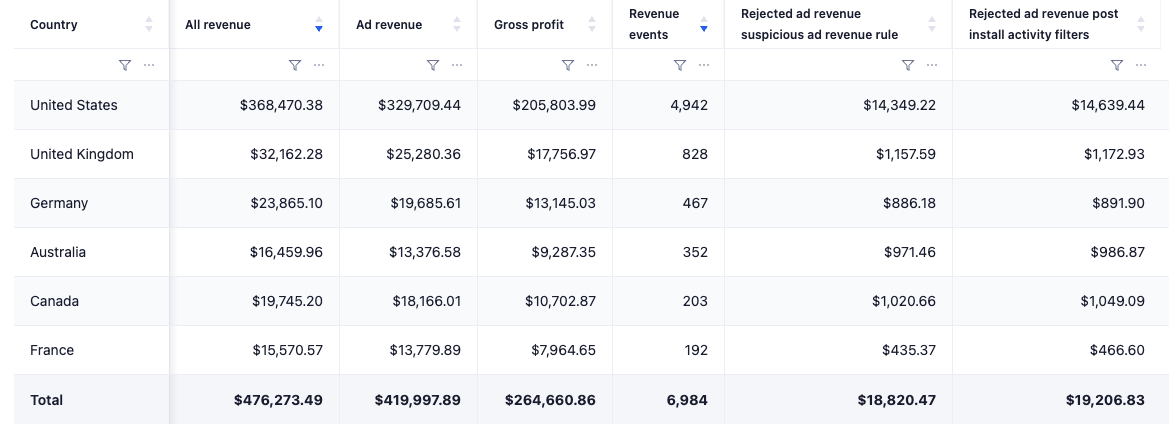
Rejected ad revenue is reported as:
- Callbacks and CSV exports when a Rejected ad revenue trigger is configured. The {rejection_reason} placeholder is evaluated as
post_install_activity_ad_revenue_rule. - Rejected ad revenue metrics in Reports, with a Reason for rejection breakdown:
rejected_ad_revenue_post_install_activity_ad_revenue_rule(Suspicious ad revenue rule)rejected_ad_revenue_post_install_activity_rule(Post install activity filters) — preserved for backward compatibility
Test mode results
Rules in Test status do not reject ad revenue, even if the rule fails. Rejected ad revenue is shared with customers in test mode — matching the behavior of live mode. Results are shared with customers only and are not forwarded to partners.
To distinguish test vs. live results, add the {conversion_rule_status} placeholder (test / live) to your setup.